Tours & Travels Business Case Study — India
How to Start a Tours & Travels Business in India — A Complete Startup Guide
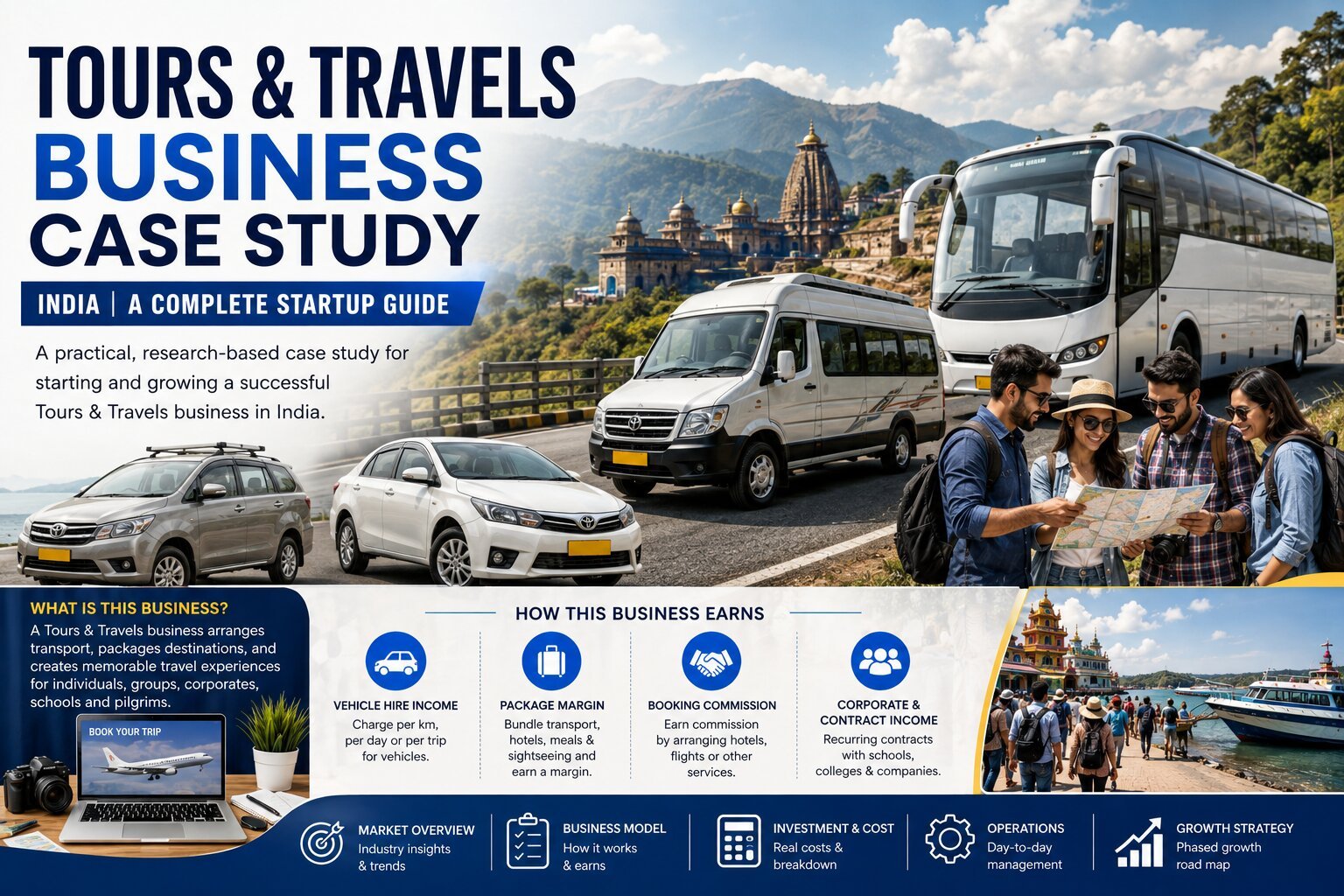
This case study has been prepared by Growholic Corporation Pvt. Ltd. as a practical, research-based reference for anyone evaluating a Tours & Travels business in India, with particular relevance to tourism and pilgrimage-linked markets such as Maharashtra and Nashik. It walks through the business model, compliance, investment, pricing, operations, and a phased growth path — in the order a first-time entrepreneur would actually need the information.
What Is This Business & How Does It Earn?
A Tours & Travels business sits at the intersection of three activities: arranging transport for travellers, packaging destinations into a saleable tour, and sometimes owning the vehicles that move people. Most operators start with one activity and add the others as they grow.
Revenue comes from four main sources:
Charging per kilometre, per day, or per trip for a car, Tempo Traveller, or bus — with or without a driver.
Bundling transport, hotels, meals, and sightseeing into a single package and charging a margin over the total cost.
Arranging hotels, flights, or third-party vehicles and earning a commission or service fee without owning the underlying service.
Recurring arrangements with schools, colleges, or companies for regular transport or tour services, usually at negotiated rates.
Types of Tours & Travels Businesses
Half-day and full-day city circuits, one-day outstation trips, and airport transfers.
Family tours, group bookings, and pilgrimage circuits — in Maharashtra, destinations such as Shirdi, Trimbakeshwar, Shani Shingnapur, and Pandharpur generate strong, consistent demand throughout the year. For verified pilgrimage destinations and circuits in Maharashtra, the Maharashtra Tourism official website is a reliable reference.
School educational tours, college excursions, corporate offsite travel, and regular employee transport contracts.
Tempo Traveller rental for group travel, tourist bus service, and customised tour packages with hotel and transport bundled.
Domestic tour packages across Indian destinations; international packages are usually built in partnership with a destination management company (DMC) rather than executed entirely in-house at the start.
Which Business Model Is Best for a Beginner?
There is no single “best” model. The right starting point depends on available capital, risk tolerance, and how much time the founder can devote to daily operations.
| Model | Investment | Risk | Key Note |
|---|---|---|---|
| Home-based / attached-vehicle | Lowest | Low | No EMI; source vehicles from owners per trip; thinner margin per trip. |
| Own 1 car (cab-based) | Moderate | Moderate | Full margin on every trip; vehicle earns nothing on idle days. |
| Tour-package model | Low to Moderate | Moderate | Margin from spread between supplier cost and customer price; needs strong supplier relationships. |
| Tempo Traveller | High | Moderate–High | Best once repeat group-travel demand is proven. |
| Bus-based | Highest | Highest | Not recommended as a first vehicle; enter only after stable Tempo Traveller operations. |
Vehicle Investment — Real Costs
Car (Sedan / SUV)
The most common entry point is a commercially registered sedan. The Maruti Dzire Tour — a popular choice among travel operators for its fuel efficiency and low maintenance — was priced at approximately ₹6.05–7.74 lakh ex-showroom, with an on-road price (including RTO, insurance, and registration) of approximately ₹6.8–8.7 lakh depending on variant and state. An SUV like the Maruti Ertiga starts from approximately ₹8.9 lakh ex-showroom for entry variants. These are not private-car prices — a tourist vehicle must carry a commercial (transport-category) registration, not a private one, which affects both the RTO fee and the insurance premium.
Typical Car Setup Cost (one vehicle)
Tempo Traveller
A Force Traveller 12-seater — the most common choice for group tours in India — is priced at approximately ₹14.23–17.81 lakh ex-showroom for the 3350 wheelbase models (as per Force Motors’ published price list). On-road price including registration, insurance, and permit typically ranges between ₹17–22 lakh depending on state and AC/non-AC variant. This is a significant commitment and should be made only after consistent demand from groups of 8–12 travellers is proven.
Typical Tempo Traveller Setup Cost (12-seater)
A Tempo Traveller typically earns ₹5,000–8,000 per day on local and group tours (based on prevailing market rates for tourist vehicles). Break-even depends entirely on how many booked days per month can be consistently achieved, especially in the off-season.
Bus
A 35–45 seater tourist bus (new) costs approximately ₹35–70 lakh or more depending on AC/non-AC and standard vs. luxury coach configuration. The single biggest financial risk specific to buses is the empty-return leg — a bus booked one-way for a large group often returns without passengers. Experienced operators price outstation bus trips to cover the round trip rather than only the loaded leg. This category is recommended only once Tempo Traveller operations are stable and recurring large-group demand (20+ seats) is proven.
Vehicle Documents & Permits
Every tourist vehicle operating commercially in India needs all of the following to be simultaneously valid. A lapse in any one of them — not just the permit — is what typically causes a vehicle to be stopped or impounded at a check-post.
Driver Requirements
Every driver carrying paying passengers legally needs two things beyond an ordinary licence:
Before hiring any driver, verify: police verification certificate, medical fitness, address proof, driving licence validity, PSV badge validity, and at least two references.
Driver salaries — a car driver in a small travel business in Maharashtra typically earns between ₹12,000–20,000 per month fixed, plus outstation allowance (food and accommodation on multi-day trips). A Tempo Traveller or bus driver typically earns ₹18,000–30,000 per month fixed, plus allowances. These are approximate market ranges; verify with local operators before finalising.
Pricing Your Services
Marketing That Actually Works
Free, high-impact, and usually the first thing a local customer checks. Complete it fully with photos, services, accurate hours, and respond to every review before spending on anything paid. This is the single highest-return marketing action for a new travel operator. Learn how to set this up at business.google.com.
Formalise what already happens organically — offer a small incentive (a discount on the next booking) for a referred customer who actually books.
Share tour offers with past customers, send booking confirmations, and maintain a customer database. Doubles as both a service and a marketing channel at near-zero cost.
Slower to build but produces the most stable, contract-based recurring revenue once established. A hotel that refers guests to your cab service will send you business every week without advertising cost.
Still relevant for pilgrimage and local markets where a meaningful share of customers are less digitally active. A well-branded vehicle on a popular route is a moving advertisement.
For a broader understanding of how digital marketing can grow your travel business, see our guide on social media marketing for local businesses in Nashik.
Biggest Mistakes to Avoid
Why Your Travel Business Needs Digital Marketing
- Most travellers now search online before booking any tour or cab service
- A complete Google Business Profile alone can generate consistent inbound enquiries at zero cost
- Social media posts showing real trip photos and happy customers build trust faster than any brochure
- Online reputation (reviews) directly influences how many people call you vs. a competitor
- A well-run digital presence lets a small operator compete with established agencies on equal footing
Frequently Asked Questions
1. How much money do I need to start a Tours & Travels business in India?
A home-based, attached-vehicle model requires mainly working capital of around ₹1–3 lakh. Adding one commercially registered sedan (like a Maruti Dzire Tour) brings the total startup cost including down payment, registration, permit, and insurance to approximately ₹8–15 lakh, depending on the vehicle and your state’s costs. A Tempo Traveller-based startup requires approximately ₹25–40 lakh including the vehicle, setup, and working capital buffer.
2. Can I start a travel business with one car?
Yes. Starting with one commercially registered car, supplemented with attached vehicles for larger bookings the owned car cannot cover, is the most common and recommended approach for first-time entrepreneurs. This lets you learn the booking cycle, pricing, and customer-service side without committing to a large loan burden.
3. What permits are required for a tourist vehicle in India?
Every tourist vehicle needs: a commercial (transport-category) registration, a Tourist Permit (State Permit for single-state operation or an All India Tourist Permit via the VAHAN portal under the 2023 AITP Rules for inter-state tours), a Fitness Certificate, PUC certificate, commercial passenger insurance, and road tax. All of these must be simultaneously valid — a lapse in any one is what typically causes a vehicle to be stopped at a check-post.
4. Is police verification necessary for drivers?
Yes. Police verification is part of the standard hiring process and is also required for the PSV (Public Service Vehicle) badge that every driver carrying paying passengers must hold, in addition to a commercial driving licence. Driving a public service vehicle without a valid PSV badge is an offence under the Motor Vehicles Act, independent of holding a valid driving licence.
5. Which tours have the highest demand in Maharashtra?
Pilgrimage circuits such as Shirdi, Trimbakeshwar, Shani Shingnapur, and Pandharpur are consistently high demand. Family outstation tours, school trips, and corporate travel also generate strong bookings. Peak booking periods are summer holidays (April–June), Diwali season, Christmas and New Year, and long weekends. The monsoon months (July–September) are typically the softest for sightseeing tours.
6. How do I get my first customers for a new travel business?
Complete your Google Business Profile fully — this is the single highest-return free action for any local travel operator. Build referrals from your existing personal and professional network. Build relationships with local hotels, schools, and corporate offices. Use WhatsApp Business to stay in touch with past customers and share tour offers. Spend money on paid advertising only once you can measure what a booking actually costs you to acquire.
Prepared by Growholic Corporation Pvt. Ltd. — Research & Business Case Studies Division | View all case studies
Disclaimer: All figures are approximate, based on publicly available market data, and are for planning reference only. Costs vary by state, city, vehicle model, and financing terms. This is not financial, legal, or investment advice. Verify current fees, permit conditions, and tax rates with your local RTO, a chartered accountant, and the applicable state transport authority before acting on this information.